Showing posts with label james river. Show all posts

Monday, September 24, 2007

Conquering Belle Isle

Today, on the second day of Autumn, the weather in Richmond was decidedly summery. With weather.com predicting 88 and sunny, I decided that today was the day that I would finally visit Belle Isle. The fact that I hadn't been yet is a bit puzzling; I live less than a mile away and often walk down canal walk from 14th street until just before the Lee Bridge.

It may have taken me a year to get my act together and visit, but seeing Belle Isle reminded me once again how impressed I am with the James River Park System. The James is truly beautiful, and Richmond has taken full advantage of it with their parks and trails. I found Belle Isle particularly interesting because of its history of habitation. As you walk around the island you see reminders of several economies of the Island's past: a mill, an extensive logjam, the skeleton of the ironworks building, remnants of the civil war prison camp. In each case, Belle Isle has won: no one occupies the island. While in most cases, I would be disturbed by a natural resource like Belle Isle having a highway cross over it, somehow the building remnants make it seem natural. Belle Isle is beautiful but it is also unique in that man has not been able to resist or conquer it.

My walking tour of the isle took about an hour, but I could have stayed much longer. For today's trip, I stuck to the main pathways because I have a terrible sense of direction and needed to ensure that I had some time left in my afternoon to work. After taking my first loop around Belle Isle, I know I'll come back when I have more time to explore -- and when I'm wearing shoes instead of flip flops. However, just from walking the main loop I got a beautiful view of the James and some geese who had claimed a rock, saw Hollywood Cemetery across the river, visited the quarry and explored many decrepit buildings. Best of all, I found a new place to escape my everyday: a small, shady stretch of beach with a great breeze.

Saturday, July 21, 2007

Pony Pasture Rapids: Take Two

After last week's failed trip to the Pony Pasture Rapids, I drove out again today to see if I could find a parking spot. Luck was with me and I arrived to find the parking lot half empty. I've just returned from spending the afternoon wading around Pony Pasture and am convinced that it is my favorite place in the city. I'm sure I'll be returning as long as the water stays warm, as pony pasture seems like a great place to de-stress and enjoy the river.

The part of the river that Pony Pasture is on is filled with huge flat rocks that look like giant turtles. Up close, the rocks look almost cantaloupe textured, and make wonderful sunbathing spots. Just sitting on a rock for ten minutes - water rushing all around me, breeze rustling the trees, sun overhead - is the most relaxing thing I've done in a long time. If I had brought a book and some suntan lotion, I would still be there.

Forget Windsor Farms, I'm moving to Riverside Drive.

Saturday, July 14, 2007

Pony Pasture Rapids: Take One

After coming to the surprising realization that people can swim in the James River (being from Chicago, swimming in rivers seems like not one of the smartest things to do), I became determined to find the best spot to try it myself. I had heard good things about Pony Pasture, so off I went. Apparently, though, I'm not the only one who thought that a day at Pony Pasture sounded like a good idea. After circling the parking lot for twenty minutes with no luck, I gave up and resolved to come back next week.

The whole trip was worth while though, because I found my new favorite advertisment at a flower shop near the rapids.

Sunday, June 10, 2007

Drewry's Bluff / Fort Darling

My second stop today was at the site of Fort Darling. While the fort is long gone, evidence of its presence is still incredibly visible. After walking through the woods for half a mile or so, I came to the site of the fort, which is on Drewry's Bluff overlooking the James River only a few miles from the site of Henricus.

At the site of the fort, mounds of earth about twelve feet tall mark the old boundaries. I was amazed to see that more than two hundred years after the Battle of Drewry's Bluff ( for more information see: http://en.wikipedia.org/wiki/Battle_of_Drewry's_Bluff ) in 1862, the fort's underground tunnel and bomb shelter are still visible.

Aside from the history, which is amazing, I highly recommend Fort Darling as a picnic site for a sunny day.

Citie of Henricus

Today I visited the historic Citie of Henricus in Chesterfield County. Founded in 1611, Henricus was the second permanent settlement in Virginia. The city was started by Sir Thomas Dale, on instructions from the London company when they wanted a more suitable location for a colony than the swampy land at Jamestown. It is in the same area where Pocahontas grew up, and is situated on a bluff overlooking a beautiful part of the James River.

To get to Henricus from Richmond is almost a straight shot down 95 South. As I got closer to the historic site, the land was beautiful and smelled fresh and green. But then everything changed. Suddenly, after turning down what looked to be a small country road, I was greeted by the site of an enormous power plant whose facilities run almost to the edge of the road. Piping stretched as far as I could see, and the grounds were filled with towering piles of coal. It was at this point that I got a bit nervous. what kind of historic village exists in the middle of a power plant? And should I really be driving this close to all that scariness? I have a vivid imagination, and all I could think about was blowing up. After rounding one more curve I was back to the Richmond countryside and through the gates of the Henricus site. Given the amount of billboard advertising leading up to the site, I was surprised at the lack of immediate excitement. There were only three other cars in the parking lot when I arrived. For six dollars I got a pass to the site and was ready to go.

The Henricus site includes both an Indian village and the colonist's village. In the Indian village I met an Indian in full leather get-up complete with fringe. My Indian friend, who was in reality a middle-aged balding man with a serious southern accent, was planting tobacco with a small wooden tool. While he wasn't very good at role playing -- he talked to me about the celebrations that were taking place for the 400Th anniversary of Jamestown -- he knew quite a lot about tobacco and told me that at Henricus they plant a strain native to Virginia.

After visiting the Indian village, I walked through the colonist site. I was slightly underwhelmed with village given its lack of instruction, but the buildings were really neat. The entire settlement's buildings are made of some kind of dried mud and stone patted into wood frames. The roof of every building is made from dried circular reeds piled almost a foot high and bound together. Looking at the settlers gardens I found myself looking at the tiny amount of tobacco that was grown. Henricus was the first place where tobacco crops were grown and cultivated for sale in Europe. While I'm sure there was more tobacco then than now, I still can't even fathom how little tobacco it took to become an international enterprise, compared to today.

After visiting the historic site I walked out along the bluff, where the view of the river was quite beautiful. On the bluff was the remains of a light house - just foundations at this point - and two statues. One, an obelisk, was dedicated by the Colonial Dames because Henricus was supposed to be the location of the first American university.

Friday, May 25, 2007

James River Plantations


This week I'm touring for two, as my Mother is in town. She is a long-time lover of plantation tours and so we spent the week looking around Williamsburg and visiting plantations on the James River. After studying up on www.jamesriverplantations.org/ we chose to visit Shirley and Berkeley.

To get to the plantations, you take 5 out of Richmond. I was immediately amazed by how quickly Richmond disappeared and we were driving through beautiful countryside. I've never thought of Richmond as a huge city, but there do seem to be endless strip malls in most directions. It was both refreshing and reassuring to find that the countryside - or at least something close to it - was only ten minutes away.

After driving down 5 for 30 minutes or so, the roadside becomes peppered with homemade-looking signs advertising the plantations. Berkeley, according to the signs, is the "most historic," while Shirley is "America's oldest family business." We chose to stop in at Shirley first since we had heard that it retained a lot of its original interior design and outbuildings.

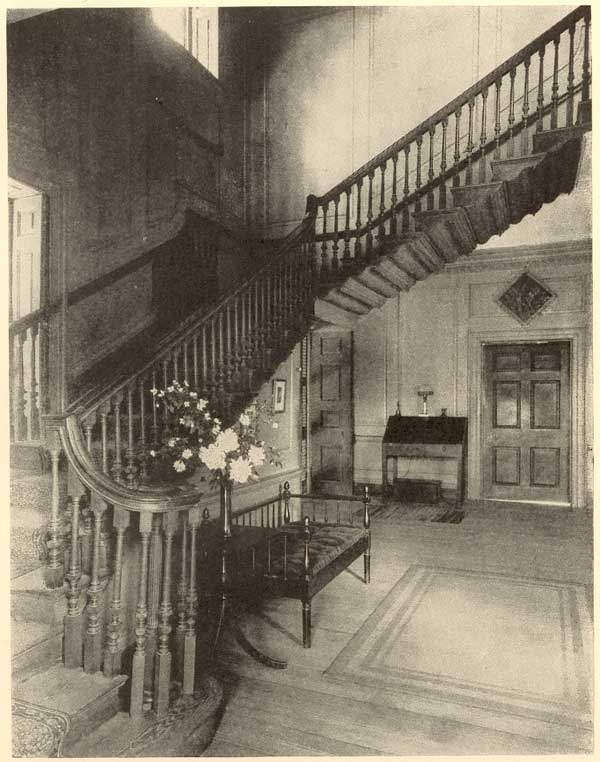
To get to Shirley, you drive down a mile or more of long, groomed gravel roads lined with fields of corn and soy. The plantation is a study in organization, with freshly mowed grass, strategically placed trees and a ground plan that is almost perfectly symmetrical. In it's long history, the plantation has survived the Indian Rebellion, the Revolutionary War, the Civil War and the Great Depression. The husband and wife who currently own Shirley live on the second floor, while their son lives on the third. Other than the gorgeous view, the most interesting thing about Shirley is the flying staircase, which is truly an architectural marvel. The flying staircase is built in a way that makes it look like there is nothing supporting it from below and like it shouldn't be able to support any serious weight. Our tour guide thought that it might be the only surviving example of such a staircase in the U.S. When we expressed curiosity about how it was built, he said that for a long time, no one was quite sure. Eventually, portions of the staircase were torn out to solve the mystery, and it was found that huge cast iron rods run through the entire thing, and are attached to the walls on either side.

After taking the tour of Shirley and walking around the outbuildings, we got back in the car and drove to Berkeley. Only five minutes away on the same road, Berkeley has an entirely different look and feel. Where Shirley is completely organised and geometrical, Berkeley feels almost like a plantation gone wild. Berkeley has had a much more eventful history than Shirley - trading ownership many times and not faring quite as well in war times - and so it has lost much of its authenticity. Eleven outbuildings are missing from the grounds, but the gardens are still in perfect condition. We walked from the house down to the water through terraced gardens and huge old trees, and I remembered how much I love being on the water. Berkeley is on a beautiful stretch of land on the river, and the plantation truly takes advantage of the view.